
I had to replace my car last year. My old car was difficult to navigate and if I hit
a bump it would pull hard to the right. I should have taken it in immediately to
be checked but I was busy and kept putting it off. By the time I brought the car to
be serviced my right front tire was completely worn, the ball joint needed to be
changed as well as tie rod ends. I was told it all could have been prevented with
an alignment. What could have been an easy fix ended up being an expensive
repair. That’s what I’ve been telling clients for years. When we are out of
alignment, joints wear quickly, and tissue breaks down. The longer the problem
continues, the more damage and the more difficult the repair. It was fascinating
to me to see the amount of damage that had occurred in a relatively short period
of time.
One of the pioneers of body alignment is a gentleman named Dr. Vladimir Janda.
He made a life study of understanding the predictable pattern of muscular
compensation and postural imbalances. Dr. Janda was the first to identify what
he called the Upper Cross Syndrome. His work speaks of forward head posture
causing strain to the muscular attachments of the shoulder and shoulder blade
producing a rounded shoulder appearance.
A quick test to see if rounded shoulders are affecting your posture is to dangle
your arms at your side and extend your thumbs. When your arms hang at your
side in a relaxed position, your thumbs should be facing forward not turned in
towards your leg. If your thumbs are turned inwards, it probably means you are
affected by rounded shoulder posture. This change in shoulder joint position
creates a lot of stress on the shoulder. But it’s no wonder shoulders can get
repositioned to that rounded forward posture. Think of all the activities you
perform in an average day. You may notice most of our daily activities take place
in front and in the centre of our body. Most shoulder problems develop from
poor joint biomechanics and muscular movement imbalances.
Injuries usually happen in a predictable pattern affecting our bodies first with
impingement, tendonitis, and bursitis and eventually ending in rotator cuff
injury. So, we can do all kinds of exercises to fix the shoulder but that would be
like me just changing my tire. It really doesn’t address the alignment problem
and the tire is just going to wear down again. Proper rehabilitation for many
chronic shoulder injuries must include protocol for reversing the upper crossed
syndrome. So, how do we do that?
The three most important things to remember with shoulders is great posture,
light weights, and shoulder blade mobility. One of my mentors for developing a
shoulder exercise program is Dale Buchberger. Mr. Buchberger’s motto is that
the shoulder blades are the centre of the universe for shoulder health. Have you
ever had difficulty raising your arms overhead? That’s a huge problem if you
want to be able to perform everyday tasks such as washing and combing your hair
or changing a light bulb. We lose about a third of our range of motion if our
shoulder blades won’t elevate and retract. That’s huge!
To keep the shoulder blades moving in all directions we need to keep the rotator
cuff muscles happy and healthy. Your rotator cuff is made up of muscles and
tendons that keep the ball of your upper arm bone in your shoulder socket.
Shoulders have a huge range of motion so they are inherently unstable. Simply
put, the shoulder joint is sort of like balancing a golf ball on a golf tee. If the tee is
crooked or tipped forward the ball just won’t stay on. The rotator cuff is made up
of four muscles which help to raise and rotate your arm. The supraspinatus
which holds your humerus in place, keeps your upper arm stable and helps lift
your arm. The Infraspinatus is the main muscles that lets you rotate and extend
your arm. The Teres Minor is the smallest rotator cuff muscle whose main job is
to assist rotation of the arm away from the body and the Subsacpularis helps hold
your upper arm bone to your shoulder blade and assists when you rotate your
arm, hold it straight out and lower it. Small muscles respond to small weights.
Something I’ve noticed in the gym is many people use too heavy of a weight to do
joint stabilizing exercises. Heavy weights are great for building big muscles but
they are not your friend for strengthening the smaller muscles that stabilize the
joints. Always work within a pain free range of motion.
Exercises to Strengthen the Rotator Cuff Muscles
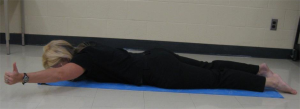
Lower trap exercises help us improve posture and increase shoulder stability.
Start by lying on your stomach. This is a great exercise to do in bed. It is
important that the head is supported by placing a hand or a pillow under your
forehead. Extend the other arm out to your side. Inhale to prepare then exhale
and lift the arm with your thumb pointing towards the ceiling. Go as high as
possible but stay pain free. Rpt. 8x
Standing 3 way:
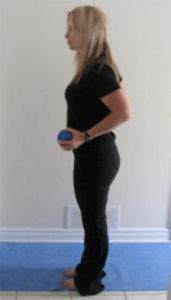
Begin with a two or three pound dumbbell, or two water bottles. Start by pulling
your elbows back like you are trying to touch them together behind your back.
Make certain that when you look down you can see your hands. Rpt: 5x.
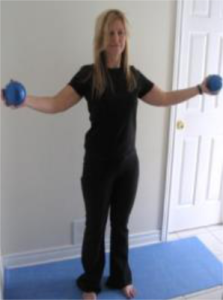
Next lift both arms straight in front with your thumbs facing up. Lift & lower 5x.

Next, take your arms out a little wider but make sure you can still see your elbows
and wrists in the periphery. Lift and lower in this widened position 5x.
Hitch Hike
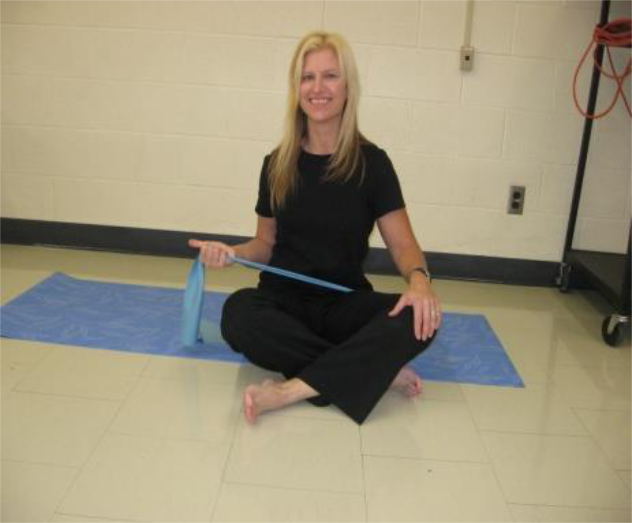
This exercise can be performed by sitting on a resistance band. Keep your elbow
tight to the side of your body. If you are having a difficult time keeping the elbow
next to your body roll up a towel and place it between your elbow and your ribs as
you externally rotate the forearm. Think of your forearm being the door and the
elbow being the hinge. Then open and close the door. The movement should be
initiated at the shoulder blade not from the front of the body. If the motion is
painful you may want to start with a belt instead of a resistance band so the arm
isn’t actually moving. This is a great first step. Rpt. 5-10x

Drawing the Sword: Shoulder Blade Mobility
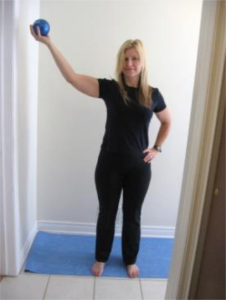
Now with only one weight, imagine you are putting the weight in your front
pocket by reaching across the body. Next lift the weight in a diagonal movement
across the body as you turn your thumbs up like you are drawing a sword and
then returning it to its sheath. Rpt: 5-10x

Part of my fascination with Pilates is that it really focuses on joint strength.
Joseph Pilates put it something like this. Think of a tree. Most people go into a
gym and strengthen their arms and legs which is a lot like strengthening the
branches of the tree. If the branch is strong but it’s falling off the tree how
important is that strong branch? And if the trunk is weak, how can the tree make
it through a storm? We are only as strong as our weakest link. That is why joint
strengthening is a valuable addition to every exercise program.