
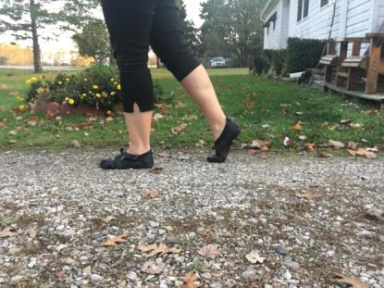
For the past few weeks, I have written about the importance of feet and alignment.
Walking is one of the best exercises to strengthen your feet and improve cardiovascular
fitness. Most of us don’t think about walking. We’ve been walking our whole lives and
by golly we know how to walk, right? What you may not realize is that gait changes can
occur due to aging, tight muscles, and injuries. Also, our gait changes when our balance
changes. This is something I’ve really had to pay attention to since my concussion. With
every step forward you are performing a one-legged balance. If your balance is not so
good, you may stop lifting your feet and do more of a shuffle. That may feel safer, but it
is not good for a few reasons.
- When you shuffle step, you are not heel striking and pushing off of your toe which
means that you are not exercising the feet and taking advantage of the rebound
system and shock absorption that our feet provide. - Also, if you shuffle your feet or don’t lift them properly there is more friction from
the ground which is hard on your low back. You also lose flexibility in your ankles
and strength in your calf muscles. - And, if you stop lifting your feet to walk, you are more inclined to catch your toe
and trip. The probability of falling increases with this shuffling gait
So, what is proper gait? It starts with a heel strike. When you swing your leg forward to
walk, the heel should be the first part of your foot to strike the ground. Next, is the foot
flat or stance position, where the weight shifts from your heel onto the full surface of
your foot. During this phase you transfer the full weight of our body onto the front foot
preparing to lift the back foot. The back foot can now lift off the ground to ambulate
forward. Toe off or the propulsion stage comes next. Toe off sets the foot and leg up for
pushing off the ground to propel that leg forward for the next step. The final stage is the
swing stage. This occurs right after you push off of the toe. Once the push off has
occurred the knee is bent and the leg swings forward. Once the leg moves past the body
for its next step, the cycle begins again when the heel hits the ground. This all happens
over and over again moving us forward.
Now let’s take a moment to think about what is required from our body to make this
happen. We need to be able to extend our hip, and we need enough flexibility in our
ankles for heel strike and toe push off. When the body shifts into swing phase, we also
require strong core muscles to stabilize the spine and pelvis as we shift the weight from
one leg to the other.
As we age, we commonly slow down. For older adults, walking, standing up from a chair,
turning, and leaning are necessary to live independently. Gait speed, chair rise time, and
the ability to do tandem stance (standing with one foot in front of the other like you are
standing on a balance beam) are important predictors of how safely we can live at home.
According to a study by James O. Judge MD at the University of Connecticut School of
Medicine, the speed we walk stays relatively stable until the age of 70. His studies show
that after the age of 70 most adults lose about 15 percent of their walking speed per
decade. Gait velocity is a powerful predictor of how well we function. Gait velocity slows
down, however, because the strength of our calf muscles substantially decreases with age
resulting in shorter steps.
This week I am hoping that you take the time for some mindful walking. Focus this week
on your heel strike and toe push off. Next week we will talk more about some common
abnormal gait problems and a few exercises to help put the bounce back in your step.

