
Are daily activities getting to be a pain in the neck? Have you ever had the sensation of
numbness or tingling in your hands or fingers when driving, gardening, playing
pickleball or golfing? Did you know that sometimes shoulder, wrist and neck pain can
be a direct result of poor posture?
How is your posture? You can do a quick posture check by standing with a broom stick
or dowel placed behind your back. If you have good posture, you will find that you can
press your head, shoulders, and buttocks against the dowel when seated or standing. If
your head isn’t making contact with the stick this is an indication of forward head
posture. Why is this significant? Our head is about an eighth of our body weight. This
means that for every one-hundred pounds we weigh our head weighs eight pounds.
The average weight of a head varies between 10-15 lbs. If you’ve ever held a ten-pound
bowling ball or kettle bell you would appreciate how heavy that really is. If you were to
hold a bowling ball towards the ceiling with straight wrists you could probably hold it
for quite a while without strain. If you tipped the bowling ball forward even as little as
an inch you would immediately start to feel stress in the wrist. Soon your wrist would
start shaking. It wouldn’t take long until the bowling ball was impossible to hold. That
is exactly what forward head posture is like for our spine. One rule of thumb is that for
every inch that the head is held forward in poor posture, an additional 10 pounds of
weight is felt on the cervical spine. That is like wearing a 10 lb weight as a necklace all
day long. No wonder our necks get cranky!
Did you ever notice that most daily tasks are performed in front of us and in the center
of our body? Working in this way causes our pectoral muscles to get very tight. The
pectoral muscles (often referred to as “pecs”) are the muscles that connect the front of
the chest with the bones of the upper arm and shoulder. Pecs are a huge set of muscles
and when they are tight, they pull with a lot of torque often causing the shoulders to
move and round forward. Rounding causes the humerus to sit slightly forward on the
shoulder joint leading to shoulder instability. Furthermore, in our shoulder joint there
is an area called the subacromial space where nerves pass through to go to our elbow,
wrist, and hand. This space is only about the size of your little finger. When the joint
moves forward the space for the nerves gets smaller causing neuro-compression. This
just means your nerves get squished and as a result, they quit working efficiently.
Compression of the nerve trunk can create an orchestra of symptoms. One common
symptom is pins and needles or numbness in the arms and hands, but even carpal
tunnel originates from poor posture.
Next imagine your shoulder blades as two cream pies on your back. If you tend to
round your shoulders or slump forward the pies would slide apart moving away from
each other. If there was a rubber band attached between the pies the band would
stretch as the pies slide apart. The rubber band represents our rhomboids and that is
exactly where we tend to be weak. When we sit, we should always try to create as
much space and width as we can in the front of our chest and pull the shoulder blades
back and together. Next imagine you are wearing a really nice necklace or tie and want
to show it off. Why is this important? Our shoulder blades are responsible for about
one third of our arm movement. That is huge! When we slump and they slide apart
they can’t move effectively. We need our arms to work properly to enjoy a pain free life.
Posture Perfecting Exercises
1. Flight: Start by lying on your stomach with your palms slapping the floor. Make
certain to keep your gaze towards the floor. This helps to reduce tension in the
neck. Slide your hands down towards your feet to alleviate shoulder tension.
Inhale as you unweight your head and lift the arms. Remember to turn your
thumbs towards the ceiling to help open the tight pectorals as you continue to
drive your fingers towards your heels. Hold for a five count. Repeat 3-10x every
day. This anti-gravity exercise will help improve posture.

2. Pectoral Release: Start with a tennis ball in one hand and the arm extended to
the side at shoulder height with the thumb up. Bend at the elbow drawing the
tennis ball to the chest. Place your opposite hand on top of the other hand and
then start rolling the ball in circles and towards your underarm. Find the cranky
spots and allow the tennis ball to release the tight muscle. This will help relax
the front of the chest to make the next exercise easier to perform.

Rhomboid Strengthener: Place a tennis ball or pillow under your forehead for
support. Next extend your arms to the side in an airplane position and keep the head
down as you lift your arms and hold for a 3 count. Rpt: 10-15x

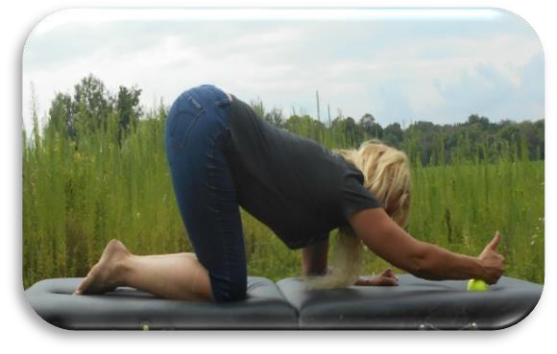
Lat Release: Chances are, if you have pain between the shoulder blades your lats are
too tight. The lats are a huge set of muscles in your back and when they are tight, they
inhibit us from raising our arms comfortably overhead. There are a couple of ways to
perform this exercise. You can start on your hands and knees. Turn your thumbs up
towards the ceiling. Push down into the tennis ball or Tubee as you roll your arm away
from your tail bone then pull your tailbone away from your hand creating length and
opposition. If it bothers you to be on your knees try standing next to a wall and rolling
the ball up the wall. Hold for approximately 30 seconds and then repeat on the other
side.

Gravity got us into this mess so let’s use anti-gravity exercises to help restore our
posture. The exercises above are easy to sneak into your daily routine and only take a
few minutes to perform and can help you in so many ways. My area of expertise is
Pilates, so I’ll leave you today with some wisdom from Joe….
Never slouch, as doing so compresses the lungs, overcrowds other vital organs,
rounds the back, and throws you off balance.” – Joseph H. Pilates