

Do you feel dizzy when you get up quickly? Or are you unsteady on your feet? If so, you
may not feel safe practicing balance exercises at home. Today I want to introduce
some simple balance exercises that can be performed in a chair. The balance system
relies on three different senses. We need our eyes so we can see what position we are in.
The sensors (called proprioceptors) in our feet and hands allow us to feel what sort of
surface we are on and how we are moving. And, we have organs in our inner ear to
sense when the head moves. To demonstrate how the inner ear affects our balance,
consider a carpenter’s bubble level? It’s a tool with a bubble in a tube that indicates
when something is horizontal or vertical. You may have placed one on a picture you
were hanging to be certain it was straight. Imagine the level was a few years old,
maybe not used very often and the liquid in the level got a little thick. The bubble
might not respond quite so well, right? That is a simplified version of what goes on in
our ears. And as we age, we tend to move our head less therefore, our “level” does not
work quite so well. One of the mobility tests used in nursing homes is to call the
resident’s name. If the resident must stop and turn their whole body to see who is
talking to them that resident is considered a higher risk for falling. This leads to
another component of balance called cervical vertigo and it involves our neck. The ears
and eyes can only work properly if they are on a stable surface. What if I put that level
on a spring? The level might be working great but the feedback it’s receiving is difficult
to decipher because it’s not stable. If our neck muscles aren’t working properly,
information from the eyes and ears will be difficult for the brain to process in a timely
manner. Your brain acts like a computer, combining signals from these three senses
(eyes, ears, and proprioceptors) to give you a stable picture of your surroundings. If any
part of this balance system is sending faulty information, then you may feel dizzy,
disoriented, or unsteady.
Someone with cervical vertigo otherwise termed cervicogenic dizziness may complain
of general imbalance, which can increase with head movements. Poor neck posture,
neck disorders, or trauma to the cervical spine can cause this condition. Cervical
vertigo can also originate from neck injuries, whiplash, or faulty head and neck
alignment.
Exercises that help improve eye, ear and neck co-ordination may make you feel a bit
“yucky” for lack of a better word. My therapist says exercises should be performed
until you reach that “Yuck” point but not beyond. For example, I get frequent
headaches with eye exercises, so as soon as my head starts to bother me, I stop. It is
tempting not to do exercises that have “the yuck” factor but when you are tempted to
skip out on doing exercises just keep in mind that falling is the second leading cause of
accidental or unintentional injury deaths worldwide.
Seated Balance Exercises
1. Vigorous Nod: Imagine you are a child, and your mom asks if you would like
some ice cream. Nod with enthusiasm. Next, would you like to clean your
bedroom? No!
With enthusiastic nodding and turning you will really engage muscles that
stabilize your neck.
2. Side Tip: If you are experiencing any sort of vertigo symptoms it is best to start
this exercise sitting on the side of the bed or couch with pillows propped up.
Look towards the ceiling and then lie down fairly quickly in one direction. Return
to seated slowly and wait for symptoms to pass before repeating. Repeat 3x lying
on both sides. You can perform a modified version in a sturdy chair. Look up
towards the ceiling and lean to the side. Repeat both directions 3x.

3. Head Turn: Extend your thumb out in front of your nose. Turn your head side
to side while watching the thumb. The goal is to perform the exercise
continuously with fluid movement as tolerated working up to 60 seconds.

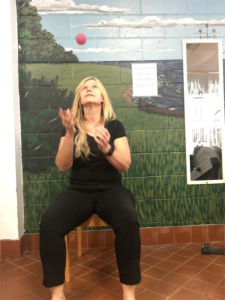
4. Ball Catch: Start by tossing a ball higher than your eyes so you must look up to
track it. Follow the ball with just your eyes and then follow with both your eyes
and your head. This is an old goalie drill and will help with hand eye co-
ordination. The goal is to work up to 60 seconds.
certain not to practice any exercise that could make you feel dizzy if you are alone. The
exercises above are based on normal head movements that you should be able to make
during your everyday life. They are safe to do unless you have been told you should
avoid certain head movements. You may want to practice slowly at first. If you have a
stiff neck, you will need to make the movements gently to start with, but the exercises
should gradually help to ease the stiffness.
If any of the movements make you dizzy, then this is a sign that your system needs
practice with these activities. Until your system has learned to cope with these
movements, you may become dizzy whenever you must carry out these movements.
Exercise is the most amazing tool you could ever find. There are so many problems
that can be resolved or minimized with the right exercise. All you need to add is a little
elbow grease.